
Overview
What the Proposed TAI Overlay District Is
The Proposed Technology and Advanced Industry Overlay District (TAI) is a zoning overlay proposed by the City of Linn Valley to guide where and how certain technology and advanced-industry uses — such as data centers and battery energy storage — may be developed, under a defined set of standards.
What an "overlay district" actually means
Regular ("base") zoning already governs every parcel in Linn Valley. An overlay sits on top of the base zoning for a mapped area and adds tailored requirements. It is a common, well-established planning tool. The overlay:
- Defines the geographic area where the rules apply.
- Lists which technology / advanced-industry uses may be considered there.
- Sets development standards and conditions those uses must satisfy.
Where could something like this go?
The overlay would apply only to a specific mapped area — and the City's clear intent is to keep it away from homes, neighborhoods, and the lake. The map below is included for one reason only: to show that the kind of location under consideration is east of US-69, across the highway from the Linn Valley residential community and the property owners' association (POA). It shows direction, not size — it is not a proposal and does not represent how large any project could be.
And the setbacks make this concrete: a facility here could not be built across the street from your home the way some have been elsewhere. The draft ordinance requires at least 500 feet from any home — 1,000 feet for large facilities.
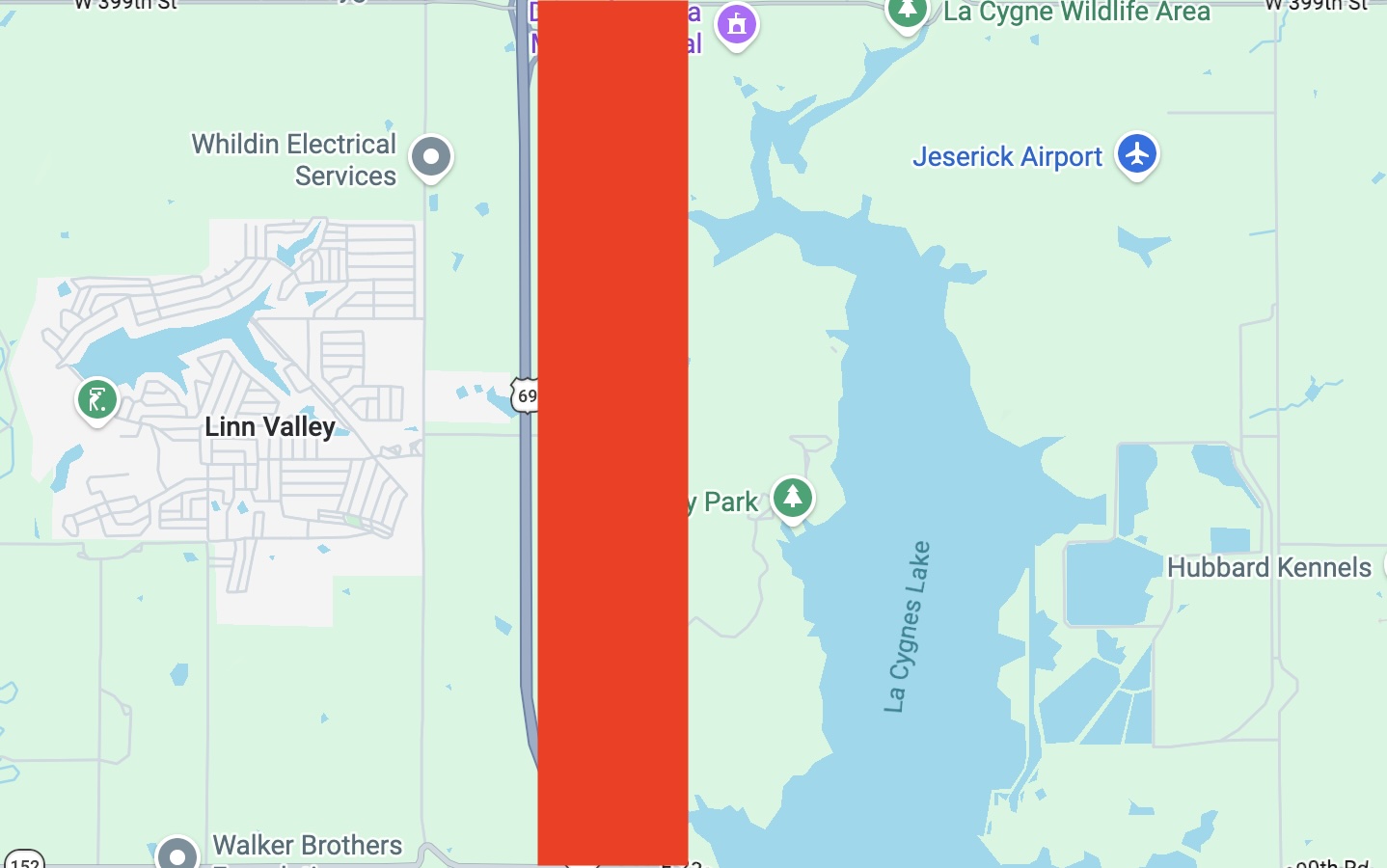
Just as important: the City would not buy this land or use eminent domain to acquire it. Any sale or lease would be a private decision by the current property owner, and annexation into the City is voluntary. (See Will the City buy property or use eminent domain?)
What about small battery projects? The district is focused on keeping large uses east of US-69. Small grid-support facilities like battery storage may also be appropriate at existing utility sites (such as a substation), which can be outside that area — because they belong next to the grid equipment that's already there. Wherever any facility is located, the same protections apply: at least 500 feet from any home, full screening, fire-safety, and dark-sky standards. (More in the FAQ.)
What the Proposed TAI Overlay District is — and is not
✓ What it is
- A framework with standards for reviewing technology and advanced-industry projects.
- A way to concentrate these uses in an appropriate, mapped area rather than scattered across town.
- A tool to attach conditions (noise limits, setbacks, screening, water and safety requirements) before anything is built.
- A public process — projects are reviewed in open meetings where residents can comment.
- A potential source of tax base and investment for City services.
✕ What it is not
- Not automatic approval of any specific project — each proposal is still reviewed on its own.
- Not a change to your home's zoning or a forced rezoning of existing neighborhoods.
- Not a blank check — uses outside the overlay's list are not permitted by it.
- Not a decision made behind closed doors — adoption and projects go through public hearings.
- Not a commitment that removes the City's ability to set or enforce conditions.
Uses the district is intended for
Two uses come up most often, so it's worth being precise about what each one actually is — and what it is not. A lot of worry comes from picturing the wrong thing.
Data centers
A data center is a secured building full of computer servers and networking equipment — the machines behind websites, cloud services, business software, and online storage. Once running, it is largely automated: it needs reliable electricity, cooling, internet connectivity, and physical security, but relatively few people on site.
✓ What a data center is
- A building that stores and processes data.
- Low day-to-day traffic and few employees once operating.
- A user of power and (sometimes) water for cooling — the main things the City reviews.
- Quiet most of the time, behind fencing and screening.
✕ What a data center is not
- Not a factory — no assembly lines, smokestacks, or industrial air emissions.
- Not a high-traffic site — it does not generate shopping-center or warehouse truck volumes day to day.
- Not a chemical or hazardous-materials plant.
- Not, by default, a cryptocurrency mining operation — our proposed ordinance specifically calls out crypto-mining and treats it as a distinct use that would require additional information and separate review before it could be considered. Under Section 5, it must clear enhanced findings — including proof of significant local economic benefit — and it can be denied.
Common resident questions concern energy use, water use for cooling, and noise from cooling systems and backup-generator testing. See our Concerns & Responses page for how the City addresses each.
Want the detail? For what actually happens inside a data center, what one looks like, and how they're cooled and powered, see How It Works.
Battery energy storage (BESS)
A battery energy storage system stores electricity — typically in lithium-ion batteries — and releases it back to the grid when it's needed, such as during peak demand or to firm up renewable energy. Think of it as a large rechargeable reserve that helps keep the grid stable.
✓ What battery storage is
- A facility that stores and re-delivers electricity, improving grid reliability.
- Engineered to fire-safety codes (notably NFPA 855) with monitoring, detection, and suppression.
- Unstaffed and quiet most of the time, behind fencing and setbacks.
- Made of components that are increasingly recyclable.
✕ What battery storage is not
- Not a power plant — it does not burn fuel or generate electricity; it only stores and returns it.
- Not a source of routine emissions — no combustion or smokestack during normal operation.
- Not a toxic-waste dump — it's a permitted, engineered facility, not an open dump site.
- Not "a giant version of a phone battery" — utility systems are engineered with unit spacing, thermal management, and code-required safety systems specifically to contain problems.
The primary resident questions concern fire safety and emergency response. The City can require setbacks, emergency plans, and coordination with the fire district — see Concerns & Responses.
Want the detail? For how battery storage works and what a small facility could look like, see How It Works.
Other advanced industry
Beyond data centers and battery storage, the district may also contemplate other modern, technology-oriented uses — such as light manufacturing, research and development, or assembly of advanced products — each subject to the overlay's standards and only if it appears on the proposed permitted-use list.
✓ What "advanced industry" is
- Modern, technology-oriented uses — light manufacturing, R&D, and similar operations.
- Uses that must meet the same standards (setbacks, screening, noise, safety) as everything else in the overlay.
- Reviewed case by case through the same public process.
✕ What it is not
- Not heavy or polluting industry — uses like refineries, smelters, or chemical processing are outside the overlay's intent.
- Not a catch-all — only uses on the proposed permitted-use list qualify; anything else is not allowed by the overlay.
- Not exempt from the same conditions, review, and public comment as other projects.
The full permitted-use list is in Section 4 of the draft ordinance, and prohibited uses — heavy manufacturing, hazardous chemical processing, refining, mining, and waste disposal — are in Section 6.
An ordinance number and adoption date are assigned only if the Governing Body adopts it; the official overlay boundary map is published with the ordinance.
How a project gets approved
- An applicant proposes a project within the overlay area.
- City staff review it against the overlay's standards and base zoning.
- The Planning Commission and/or Governing Body consider it at public meetings where residents may comment.
- If approved, it is approved with conditions the applicant must meet and the City can enforce.
Under the draft ordinance, every use requires a Conditional Use Permit — nothing is permitted by-right (Section 3) — and approval is discretionary, decided by the Governing Body on the findings required in Section 19.