Quick answers
Frequently Asked Questions
Short, direct answers to the questions we hear most. For the full picture, see What It Is and Concerns & Responses.
The Basics
If these projects are manageable, why are so many communities against them — and why does the county have a moratorium?
A fair question — and the honest answer isn’t that those communities “don’t get it.” Most opposition is a reasonable reaction to real problems with how projects were done, not to the technology itself:
- Some facilities elsewhere were sited badly — built across the street from homes, run on diesel generators, or dropped into water-stressed areas. Residents were right to push back. The lesson isn’t “never” — it’s set strong rules and the right site first (see Concerns & Responses).
- Many fights were really about process — deals made quietly and sprung on people, so they felt blindsided. That’s why we’re doing this in the open, before anyone has approached us (see Transparency).
On the moratorium: a moratorium is usually a community hitting pause to catch up — it got approached before it had rules in place, so it stopped to study the issue and write standards. That’s prudent. The only difference is timing: a moratorium is the reactive version of caution; writing clear, strict standards before a developer ever calls is the proactive version of the same caution. (Linn County’s current moratorium is part of why any project would have to come into the City and meet our standards.)
And to be clear: some communities genuinely shouldn’t host these, and a “no” can be the right answer for that place. So the real question was never “data center, yes or no?” — it’s “are the rules strong enough, and is the site right?” — and we’re answering that before we’re ever under pressure.
Where opposition is driven by distrust or misinformation, the fix isn’t to dismiss anyone — it’s to put accurate, sourced information in front of you so you can judge for yourself. That’s the whole reason this site exists.
What is an overlay district, in plain English?
It’s an extra layer of zoning rules placed on top of the normal zoning for a mapped area. It doesn’t erase the existing zoning — it adds specific standards for certain uses (here, technology and advanced industry). Think of it as a set of “house rules” that apply only inside the marked area, on top of the rules that already exist.
Does this change the zoning of my home or neighborhood?
No. The overlay applies to a specific mapped area. It does not rezone existing residential neighborhoods or change what you can do with your own property.
The overlay applies only to the specific area shown on the City’s official zoning map; the mapped boundary is published with the ordinance.
The map below is included only to show that the kind of location under consideration is east of US-69, across the highway from the Linn Valley residential community and the POA — not next to homes:
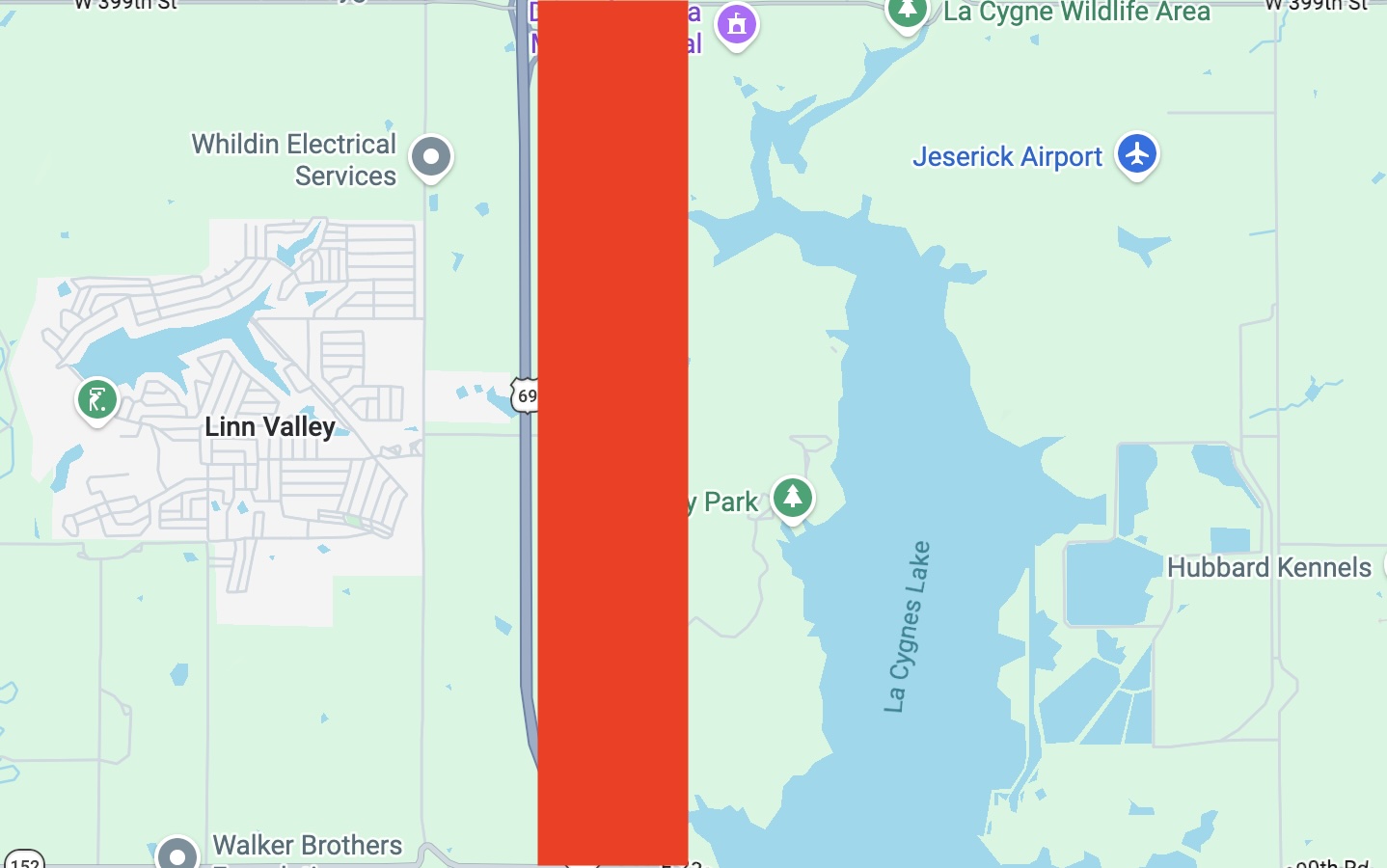
The City would not buy this land or use eminent domain to acquire it — see “Will the City buy property or use eminent domain?” below.
Could a battery storage project go outside the 'east of US-69' area?
Possibly — here’s how the City is approaching it.
The TAI district — for large uses like data centers — is focused east of US-69, away from homes and the lake.
A small battery storage facility is a different, much smaller thing. Because it supports the electrical grid, it makes the most sense next to existing utility infrastructure — such as a substation — which may sit elsewhere. The City is considering allowing small battery projects at existing utility sites, rather than forcing them into the mapped district.
The protections are the same wherever one goes: at least 500 feet from any home, full screening and landscaping, fire-safety standards (NFPA 855), and dark-sky lighting — and it would go through the public Conditional Use Permit process. No project has been approved.
Will the City buy property or use eminent domain to make this happen?
No. The City does not intend to purchase land or use eminent domain to acquire property for this.
Any sale or lease of land would be a private transaction between the current property owner and an interested party. The City is not the buyer, and it is not taking anyone’s property.
Annexation into the City is also voluntary — a property owner would choose to bring their land into Linn Valley. And because Linn County currently has a moratorium on these kinds of projects, a project like this could not move forward on land in the unincorporated county; an owner who wanted to pursue one would first need to voluntarily annex into the City, where it would then go through the City’s public review process.
What uses does the district actually allow?
The district is intended for technology and advanced-industry uses such as data centers, battery energy storage, and related advanced industry — each subject to the overlay’s standards. Uses that aren’t on the proposed list are not permitted by the overlay.
The draft ordinance’s permitted uses (each still requiring a Conditional Use Permit) are listed in Section 4: data centers; artificial-intelligence and high-performance computing; cloud infrastructure; technology campuses and research facilities; battery energy storage; electrical substations and utility support; incidental offices; and public utility infrastructure. Prohibited uses are in Section 6.
Does this allow cryptocurrency mining?
Not automatically. Cryptocurrency mining is treated as its own distinct use — it is not the same as a standard data center, even though both involve computer equipment.
Our proposed ordinance specifically calls out crypto-mining and would require additional information and a separate review before any such use could be considered. In other words, it can’t slip in under the general “data center” label.
Under Section 5 of the draft ordinance, crypto-mining is not permitted unless separately approved through enhanced findings, and it can be denied. The applicant must show significant local economic benefit, electrical-demand compatibility, noise mitigation, and compatibility with infrastructure and surrounding land uses.
Process
Will the public get to weigh in on specific projects?
Yes. Projects are reviewed in open public meetings where residents can comment. Approval typically comes with conditions the applicant must meet and the City can enforce.
Projects are reviewed by the City’s Planning and Zoning Commission and Governing Body at public meetings, and the draft ordinance also requires an applicant to hold two public information meetings before review (Section 16). Meeting dates are posted by the City.
Can I read the actual ordinance myself?
Yes — the entire draft is published on this site. We didn’t want residents to rely only on summaries.
You can read the full draft ordinance here, where every section is shown with its official text alongside a plain-language explanation of what it means. You can also download the complete draft as a PDF from that page.
Please note it is a discussion draft and may change as it moves through legal review and public input.
Is a specific project already approved or coming?
Adopting the overlay is about setting the rules and the map — it is not the same as approving a specific development. Any actual project still goes through its own review.
As of now, the TAI Overlay District ordinance is a discussion draft under review and has not been adopted, and no project has been approved by the City.
Community & Economy
What's the benefit to Linn Valley — jobs or tax revenue?
The most direct benefit of these uses is usually expanded tax base and investment rather than large numbers of jobs — data centers in particular are not big employers once operating. A broader tax base can support City services and help ease pressure on residential taxpayers.
On jobs specifically: officials in Minooka, Illinois told us a data center typically runs on about 20–25 jobs per building, averaging roughly $135,000 a year — far fewer than a warehouse’s 300–400 jobs, but at about five times the pay (their warehouse jobs averaged around $25,000), and with no truck traffic.
On infrastructure and cost: under the draft ordinance a project must fund the infrastructure its own load requires, and the City can require a professional fee agreement so the developer — not residents — pays the legal and engineering review costs. In Minooka, the developer contributed millions up front and built major road and utility improvements at its own expense — paid for by the developer, not taxpayers.
Specific projections, incentive terms, or community-benefit commitments would be shared as they are developed for any actual project. The draft ordinance also requires a Community Benefits Agreement for large projects (Section 17).